
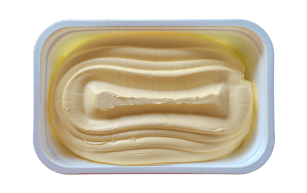
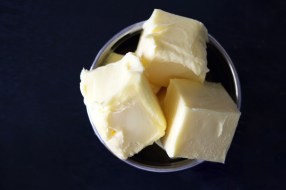
I was having lunch with a friend not long ago and she reminded me of a conversation we’d had many years before in which I said that, whatever the health advice was about eating ‘spreads’ or margarine rather than butter, I was going to stick to the natural product.
When I was a child, butter was seen as the villain of the piece and we were constantly exhorted to eat margarine, which was portrayed as a miracle product. Recently, however, butter’s reputation has undergone something of a makeover, even when compared with more modern margarines.
Studies in the 1960s had indicated that saturated fats in the diet were a major contributory factor in heart disease. As butter, in common with other animal fats, contains a high proportion of saturated fat (especially cholesterol) it was considered better for your heath to replace it with margarine.
Butter is a solid dairy product, made by churning cream or milk to separate the solid from the liquid components, whereas margarines are made from processed plant oils. The early margarines were manufactured to be solid at room temperature (unlike their plant oil precursors). In the process, the nature of the fats was altered and some fats, known as trans fats, were formed. These are harmful because they raise levels of LDL (bad) cholesterol and simultaneously lower HDL (good) cholesterol.
During World War 2, margarines had, by law, to be fortified with vitamins, in order to present them as a healthy alternative to butter. The modern versions also contain vegetable oils, ingredients that claim to reduce cholesterol levels in addition to colourings, preservatives and other additives – none of which would be found in butter. A comparison of butter with three different types of margarine is shown in the table below:
| Nutritional content per tablespoon (approx. 15ml.) | Butter | Margarine (block) | Margarine (spreadable)
Contains water in addition to the other ingredients |
Margarine (with phytosterols) |
| Calories | 100 | 80-100 | 40 | 70-80 |
| Fat (g) | 12 | 9-11 | 5 | 8 |
| Saturated Fat (g) | 7 | 2 | 1.0-1.5 | 2.5 |
| Trans Fat (g) | 0.5 | 1.5-2.5 | 0 | 0 |
| Cholesterol (mg) | 31 | 0 | 0 | 0 |
| Carbohydrate (g) | 0 | 0 | 0 | 0 |
| Sugar (g) | 0 | 0 | 0 | 0 |
ml= millilitres; g = grams; mg = milligrams
When you undergo a cholesterol test, the measurement shows the total cholesterol level along with the HDL and LDL levels. These are expressed as a ratio and the higher the HDL level is in comparison to the LDL level, the better. However, it is also true that the body makes its own cholesterol and in amounts far greater than those consumed in the diet, so what you eat may not make much difference. In any case, some people have naturally higher or lower cholesterol levels than others.
All that having been said, butter is a product that is ‘calorie-dense’ and if you want to avoid gaining weight, your intake of fats in general (including butter) needs to be limited.
For my own part, I would much rather eat a small quantity of butter than a larger amount of margarine, for the simple reason that I think it tastes so much better. It is also very satisfying to have ones instincts confirmed by medical science.
Sources: Health; The Daily Telegraph; Medical News Today
Photos from Pixabay by Aline Ponce and ‘doornekamph’ (his designation)
 Write on