
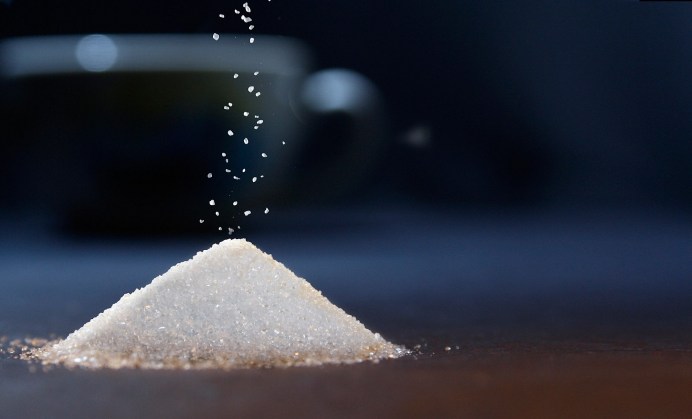
Sugar has come to be seen by many as public enemy number one in the food world.
But is this reputation deserved?
Sugar is a natural substance which can be extracted from sugar cane and sugar beet. Many of us still use it to sweeten tea and coffee as well as adding it to cakes, biscuits and puddings in our home cooking.
It is a carbohydrate and provides us with a source of energy in our diets (as with all carbohydrates, 1 gram of sugar provides 3.75 calories – this gives a value of 22.5 calories to 1 teaspoon, which contains 6 grams). As with all the dietary sources of energy, if we consume more than we expend in daily activity and the bodily processes that sustain life, then we gain weight.
The body also converts the complex carbohydrates from starches in bread, pasta and potatoes (etc.) to sugars during the process of digestion.
Many foods naturally contain sugar. Most obviously fruit, but also vegetables (in the latter case, this becomes more evident when they are cooked for any length of time, as anyone who has prepared onions by sautéing them slowly, or roasted vegetables in the oven will attest to).
It is also true that a large number of prepared foods contain sugar; many of them somewhat surprising. For example, tomato sauce and low-fat yoghurts are two products that, on the surface, would not be prime candidates for considering as high in sugar.
In any case, what do we mean by ‘high in sugar’? The experts cannot seem to agree on this; a short search online revealed that a sugar content of <5g per 100g of product is considered low, but the threshold for the designation of ‘high’ is variously either >15g or >22g. There is a significant difference between these latter two figures – one being around 50% higher than the other.
Why is sugar added to foods that are ostensibly savoury?
For example, many TV chefs recommend adding sugar to tomato sauces ‘to make them less acidic’. I find that this problem is all but eliminated if the sauce is simply cooked for longer, as the natural sweetness is able to emerge.
It seems to me that in the quest to make food palatable, we are at risk of making it all taste the same. (This reminds me of the prediction that at some point in the future, there will be no hot or cold; everything will be at the same temperature. Without the existence of temperature gradients, life as we know it would cease to be tenable).
Lower calorie products, sold to us on the premise that they contain less fat, often contain relatively high levels of sugar. The argument from the manufacturers is that when they reduce the amount of fat, they have to increase the levels of sugar in order to maintain the flavour of the food. It has also been established that people, seeing the label ‘low calorie’, are then likely to consume more of the product (over estimating, in their minds, the extent of the calorie reduction and probably consuming a greater number of calories overall). There is also an argument that because fats produce a feeling of satiety more quickly, eating food that is higher in fat might, paradoxically, make us consume a lesser quantity, hence the current recommendations in some quarters to eat full-fat yoghurts.
One way in which the manufacturers try to get around this problem is to use artificial sweeteners. These are not the panacea they promise to be either, for example, aspartame (a widely used product) has concerns regularly expressed about its use, because of the possible side effects. There is now a range of sweeteners that mimic natural products and in some cases are derived from them (for example, stevia). Some sugar substitutes can also have unfortunate effects on the digestive system if used in large amounts, and have to have warnings displayed on the containers to this effect.
For a long time, medical advice was biased in favour of reducing fats in the diet in order to lose (or maintain) weight. Some of this is based on research that goes back over 50 years and, as it turns out, was sponsored by the sugar industry (for Harvard University).
Meanwhile, the amount of sugar consumed by those eating a western diet has increased and, with the reduction of manual work (as manufacturing industries were either computerised, or superseded by cheaper competitors in the far East), the increase in car ownership (and use) and the higher levels of heating that many of us now enjoy in the winter (no more bedroom windows frozen on the inside, which was a regular occurrence in many households when I was a child in the 1960s) our weight has tended to increase, levels of obesity are at an all-time high and there are serious problems with Type 2 Diabetes (which is considered to have a direct relationship with being overweight or obese).
Other factors that might also have contributed to this problem are that food is now much more readily available round the clock; with shops open for longer hours, on Sundays since 1994 (UK) and the profusion of takeaway food outlets.
When people don’t cook from scratch and rely on ready meals or takeaway food options, they are almost inevitably going to consume higher levels of sugar, for the reasons mentioned earlier in this article.
During the 1970s there was a sugar shortage in Britain and I took the opportunity to stop adding it to tea and coffee. This by no means implies that I have overcome my liking for sugar, as I enjoy sweet treats as much as the next person.
Participation in a recent weight loss programme (with a degree of success) has made me look more closely at my sugar consumption and I have noticed that, for me at least, some products are now unpalatably sweet. This is helping me to limit the amount I eat, especially in processed foods (where the sugar content is listed as a component of the carbohydrate)
Recent research* (September 2019) seems to suggest a higher mortality rate for those consuming drinks containing artificial sweeteners than for those containing sugar. My objection to these is slightly different – as they generally seem to have a strange (and not altogether pleasant) aftertaste.
[Image from Pixabay]
*A global study carried out by WHO (the World Health Organisation) involving more than 450,000 adults in 10 countries, including the UK, found that death rates for those consuming at least two diet drinks per day were 26% higher than among those who had less than one per month (although daily consumption of all soft drinks, including those containing sugar, was linked with a higher chance of dying young).
The group consuming the diet drinks also had a 52% higher risk of being killed by cardiovascular disease.
This study was published in JAMA Internal Medicine
 Write on